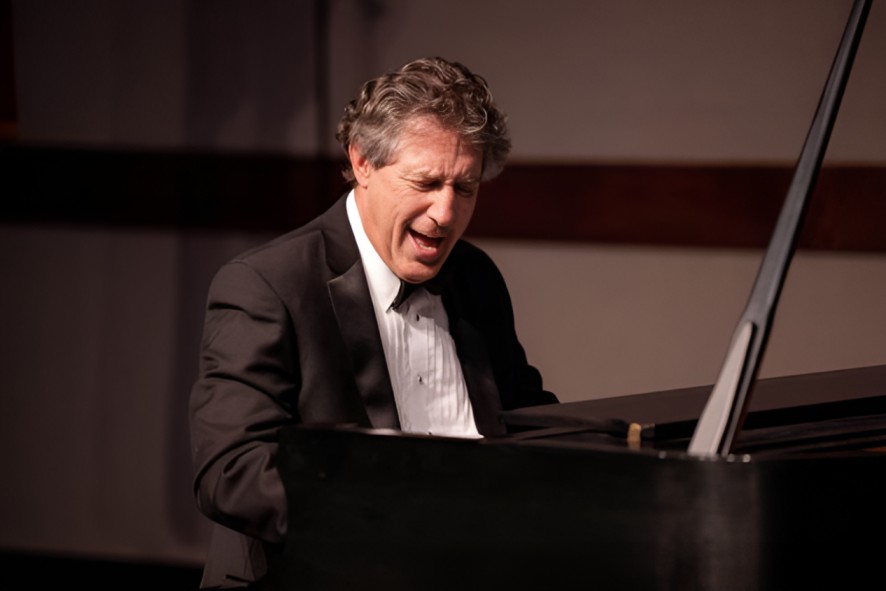
When acclaimed American concert pianist Peter Simon takes the stage, it’s never just a performance—it’s an experience. A blend of virtuosity, storytelling, and heart, his concerts transport listeners from their everyday lives into the world of beauty, laughter, and reflection. This May, Simon is taking that mission even further—bringing his music to the people of Israel during one of the most challenging periods in the country’s recent history.
From May 7 – June 7, 2025, Simon will embark on a free concert tour across Israel, visiting communities deeply affected by the events of October 7. His goal is simple, yet powerful: to bring joy, comfort, and a moment of escape through music.
“I have a lot of empathy for the Israeli people and what they are going through,” Simon says. “Therefore, I have decided to travel to Israel and give free concerts, so they will be able to hear and enjoy beautiful music.”
We sat down with Peter Simon ahead of his journey to talk about why he’s making this tour, what he’s hoping to accomplish, and how music can reach beyond pain and speak directly to the soul.
Q: You’ve toured all over the world, but this trip to Israel feels particularly personal. Why now?
This will be my fourth trip to Israel—my fourth tour, really—and I’ve always had deep admiration for the country and its people. What’s happening there now… it’s heartbreaking. There’s so much stress and uncertainty. I kept thinking: what can I do? I’m a classical pianist—I can’t change political realities, but I can bring beauty, even for an hour. If someone forgets their sorrow for a moment because of something I’ve played, that’s meaningful.
Q: What are you looking forward to most about this tour?
The smiles. That’s really it. I’ll be performing in communities that have been hit hard—one concert will be for residents of a kibbutz near the Gaza border, Nahal Oz, who are currently living in a hotel. I’ll also be playing at a girls’ orphanage in Jerusalem, and in a small town near the Golan Heights that’s been targeted by rocket fire. My goal is to make them smile. Maybe even laugh. But most of all, to remind them that beauty still exists in this world.
Q: And you’re donating two grand pianos during the trip—tell us more about that.
Yes, this is something I feel very strongly about. One grand piano will go to Katzrin, up in the Golan Heights. The second will go to Nahal Oz, where so many buildings were destroyed in the October 7 attacks. That piano will be installed in one of the new buildings, symbolizing resilience and hope. Music is not just sound—it’s culture, identity, therapy. These pianos will live on long after I’m gone, continuing to uplift these communities.
Q: Are there specific pieces you’ve chosen for this tour?
I’ve tailored a program just for Israeli audiences. There are over a million Russian Jews in Israel, so I’ll be playing Sabre Dance by Khachaturian and Ochi Chernye—which many know as “Dark Eyes.” I’ll also play music by Israeli composer Paul Ben-Haim, and of course, I’ll bring my American roots with me: Rhapsody in Blue by Gershwin is a must. The music is fun, emotional, and above all, unifying.
Q: What do you think will be the hardest part of this journey?
Honestly? The emotional weight. Seeing people—especially children—who’ve lost homes, parents, peace of mind… that’s going to be tough. I’ll be playing in a girls’ orphanage, and I know that won’t be easy. But if I can bring joy into that space, even for a little while, it will be worth every tear I shed behind the scenes.
Q: Some might say it’s risky or controversial to travel to Israel right now. What would you say to that?
People have asked me, “Why are you going now?” And my answer is always the same: because it matters now. I’m not just sending money—I’m showing up. I’m reminded of a photo I saw of Emil Gilels, the great Russian pianist, playing on the front lines for troops during World War II. Or Louis Gottschalk, the first great American pianist, who played for Union troops during the Civil War. Music has always gone to the front lines. So I go—not as a politician, but as a human being, and a musician.
Q: What do you hope audiences take away from your performances?
That even in darkness, there is light. That beauty still exists. That someone thousands of miles away cared enough to come, to sit at a piano, and say: you matter. That’s the heart of what I’m doing.

With a heart full of compassion and fingers ready to dance across the keys, Peter Simon is setting out on a journey not just of notes and melodies—but of healing and hope. Music doesn’t solve everything,” Simon says, “but it reaches the places words can’t.”
Follow Peter Simon’s journey and learn more about his humanitarian music mission at https://www.facebook.com/profile.php?id=61574261339194