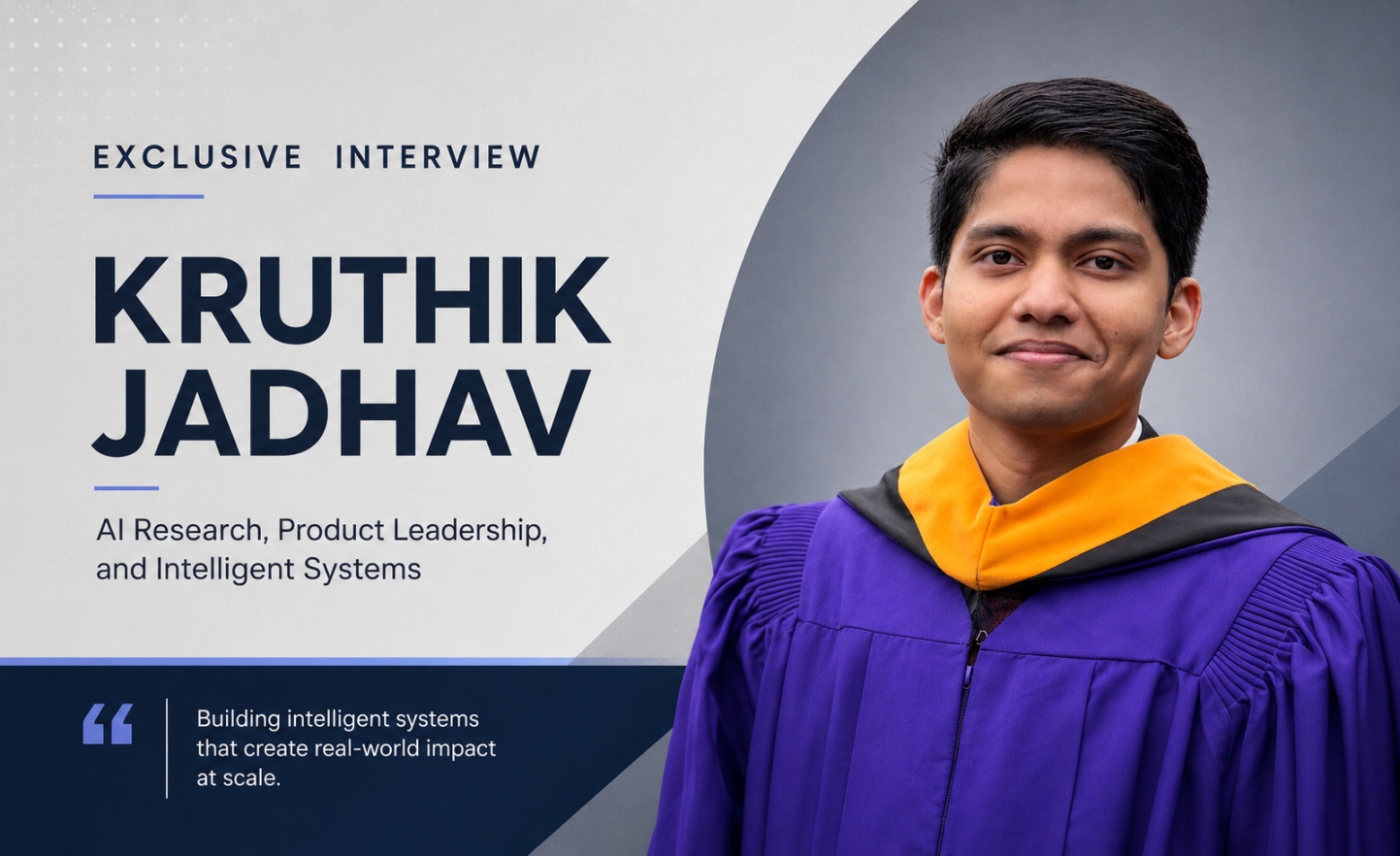
At a time when artificial intelligence is moving from research labs into everyday products, Kruthik Jadhav is building a career that connects technical depth, product leadership, cybersecurity, and intelligent systems.
With a background in computer science and management systems, Jadhav’s work sits at the intersection of AI research, software development, startup innovation, and technology management. His experience spans marketplace product development, AI quality review, software vulnerability detection, and intelligent safety systems.
In this interview, he discusses what drew him to technology leadership, what it takes to build practical AI products, why cybersecurity matters more than ever, and the kinds of problems he hopes to solve in the years ahead.
What first drew you to this mix of technology and leadership?
What drew me to this mix was the fact that I never saw technology as just code. I was always interested in how software systems are built, but I was equally interested in why they are being built and who they are helping. My background in computer science gave me the technical foundation, but as I worked on more projects, I realized that the most useful products come from understanding both the system and the user.
That naturally pushed me toward product management and technology leadership. I enjoy working on the technical side, but I also like shaping the product direction, thinking through user workflows, and making sure an idea can actually work in the real world. For me, that combination of AI, software, product, and leadership feels like the most practical way to turn technical ideas into something meaningful.
What has been the most challenging part of turning an idea into a working product?
The most challenging part has been realizing how many details sit behind what looks like a simple product idea. A marketplace platform sounds straightforward at first, but once you start building it, every feature connects to another part of the system. You have to think about onboarding, authentication, user flows, listings, referrals, shipping, trust, and how the backend supports all of it without making the experience feel complicated.
Another challenge has been knowing what to prioritize. In a startup environment, there are always more ideas than time, so the real work is deciding what belongs in the first version and what can wait. That process has taught me to be practical, move quickly, test early, and keep improving the product instead of waiting for everything to be perfect from the start.
How do you balance user experience, technical feasibility, and business goals?
I usually start by trying to understand the actual problem behind the request. Sometimes a business need comes in as a feature idea, but the first step is to understand what outcome we are really trying to create. From there, I think about the user experience, the technical effort, and whether the feature supports the larger product direction.
I try to keep the solution simple enough that users can understand it, but strong enough that it can scale as the platform grows. On the technical side, I think about what can be built cleanly, what may create future complexity, and what needs to be prioritized first. The balance comes from being realistic. A good product choice should help the user, make sense for the business, and be something the team can actually build well.
What has reviewing AI-related work taught you about quality standards behind advanced AI systems?
That experience has shown me how much careful human judgment matters behind advanced AI systems. From the outside, people often think of AI only in terms of models, automation, and data, but there is a lot of review and quality control behind the scenes.
When I review the work of AI domain experts, I have to look closely at accuracy, consistency, reasoning, and whether the work meets the expected standard. One thing I have learned is that the quality bar in AI keeps moving very quickly. Because the field is so competitive and fast-changing, the level of work expected today can be different from what was acceptable even a short time ago.
That has made me more disciplined in how I evaluate technical work and more aware of the need to adapt quickly. For me, the biggest lesson is that strong AI systems are not built by technology alone. They also depend on people who can review, question, and improve the work with care.
Why do you think cybersecurity is becoming so important in the AI era?
Cybersecurity is becoming more important because AI is now being added into systems that people and organizations rely on every day. As these systems become more powerful, the risks also become more serious.
A weakness in software can create a much bigger problem when the system is connected to sensitive data, automation, or large-scale digital infrastructure. That is one reason I became interested in software vulnerability detection.
I think AI can help identify risks faster and support stronger security practices, but it also has to be built carefully so it does not introduce new problems. In the AI era, security cannot be treated as something separate from development. It has to be part of how intelligent systems are designed, tested, and improved from the beginning.
What does serving as an IEEE MLSP 2026 reviewer mean for you professionally?
Being invited to serve as a reviewer for IEEE MLSP 2026 is professionally meaningful because it allows me to contribute to the research community from a position of responsibility. Reviewing research is not just about reading a paper. It requires evaluating the originality of the work, the strength of the methodology, the clarity of the contribution, and whether the research has value for the field.
For me, this role reflects the direction of my professional work in AI, machine learning, and intelligent systems. It also gives me the opportunity to engage with new research and understand how high-quality scientific work is assessed.
I see it as an important part of my growth as a technology professional because it connects my research interests with a broader academic and technical community. It is a role I take seriously because peer review plays an important part in maintaining standards in research.
What impact can intelligent systems have on public safety?
That project helped me understand how intelligent systems can move from theory into something that has a direct effect on people’s safety. We worked on using computer vision to detect risky driving behavior such as distraction and fatigue. What stood out to me was that even a timely alert could potentially help prevent a serious accident.
That is the kind of impact that makes AI meaningful to me. It is not only about building a model that performs well technically, but about whether the system can help people in real situations. I think intelligent systems can play a major role in public safety, especially in transportation, healthcare, infrastructure, and risk detection. When used responsibly, they can help identify problems earlier and support safer outcomes.
What kind of problems do you most want to solve in the next few years?
In the next few years, I want to work on problems where technology can make systems safer, smarter, and more reliable. I am especially interested in AI applications related to software security, intelligent systems, and products that can work at real-world scale.
I want to build things that are technically strong, but also practical enough for people and businesses to actually use. My goal is not just to work in AI because it is a fast-growing field. I want to apply it in areas where it can create real value, whether that means improving cybersecurity, building better product systems, or making intelligent tools more dependable.
Long term, I want to grow into someone who can understand the technical depth, guide product direction, and help turn strong ideas into useful systems.
From the editor…
Kruthik Jadhav’s professional path reflects a growing shift in the technology sector, where AI expertise is no longer limited to research or coding alone. His work shows how technical knowledge, product judgment, human review, and responsible design can come together to build systems that are useful, secure, and ready for real-world use.
As AI becomes more embedded in business, safety, cybersecurity, and everyday digital platforms, Jadhav’s focus remains clear: building intelligent systems that are technically strong, practical, and capable of creating real value.