In today’s world, software development faces an unprecedented challenge. The classic model where a team of backend, frontend, QA, DevOps, designers, researchers, and managers works for weeks at a high cost can feel outdated in the face of today’s market speeds. With a single sprint costing as much as a startup’s quarterly budget, and with features becoming obsolete within months, the industry is at a crossroads. How can we keep pace and innovate without being weighed down by cost and complexity?
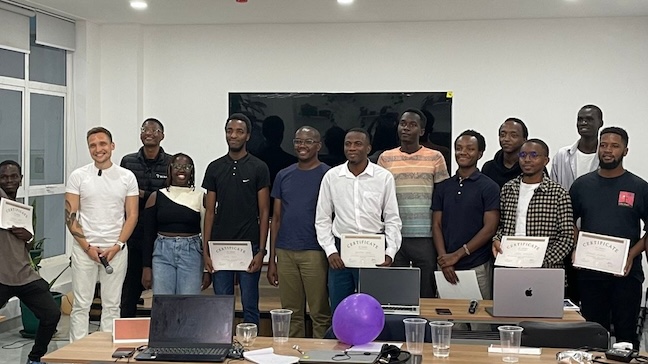
The answer, showcased brilliantly this past weekend in Nairobi, is artificial intelligence. Kenya, Africa’s “Silicon Savannah” and one of the continent’s most vibrant tech ecosystems, became the stage for the first AI-assisted programming championship: a bold, transformative response to the growing demands of modern development. This event was more than a competition; it was a demonstration of how AI is rapidly rewriting the rules of software engineering.
Why Kenya? The Rise of the Silicon Savannah
Kenya has rapidly emerged as a leading technology and innovation hub in Africa, often called the “Silicon Savannah.” The country’s booming startup scene, over 150 tech startups have sprouted from Nairobi’s innovation hubs like iHub, and widespread tech adoption have attracted major global tech companies. Google, Amazon (AWS), IBM, and Microsoft have all made significant investments, establishing development centers and confirming Kenya’s position as a regional tech powerhouse.
The country’s digital ecosystem is further enriched by major tech training programs and industry partnerships, including Google’s Hustle Academy and AI Skills programs, Moringa School’s AI bootcamps (with Google.org), and Microsoft’s AI Skilling and huge investments in cloud infrastructure. These initiatives enable Kenya’s youth to participate not just as consumers but as active innovators, making Kenya a logical host for a breakthrough AI challenge.
The Championship: More Than Just Code
Maksim Kulichenko, the championship’s organizer, educator, and engineering manager, explained the vision: “We wanted to bring together programmers, developers, and AI enthusiasts from across the country to explore the collaboration between humans and artificial intelligence. Writing code without AI is simply an outdated practice today. But integrating AI brings its own set of concerns. Can AI truly help us build better products? How do we use it to amplify our own skills?”
The structure of the Nairobi championship reflected this new reality. In the first round, teams used AI to attack complex coding specifications with minimal manual edits, a true test of technical skill and AI mastery. Daniel Kravets, AI tech lead at Vendict, designed these sophisticated challenges, pushing participants to expand the boundaries of prompt engineering.
*Vendict – AI-powered platform that streamlines and automates vendor risk management, particularly security questionnaires and compliance workflows
In the second round, contestants were required to invent and integrate meaningful new features under fierce time pressure. This phase tested architecture adaptation, strategic thinking, and deep collaboration with AI tools to achieve genuine product innovation.
A Challenge with Real-World Impact
Importantly, the challenge was a high-impact, socially relevant task. Participants were tasked with creating a website to help people quickly find the nearest specialized medical care center. The goal was to set a precedent: that impactful tools could be developed at speed, even by early-career engineers, using AI.
Mila Artemova, one of the organizers, brings a unique perspective shaped by her work as co-founder of the first inclusive educational center in the CIS, which has since evolved into a digital ecosystem connecting global tech leaders through high-impact events supporting charitable initiatives.
Mila explained: “Each of us believes that AI empowers people, and we wanted to create a truly impactful precedent.”
She continued: “We had a bold idea: what if novice engineers without expensive equipment or impressive resumes could challenge professional, well-funded teams in just one day?”
Daniel adds: “I spent around 3 work days just to collect ideas for the challenge. We had several directions to go, and picked based on potential impact, tech stack and relevance for Kenya specifically. So we gave participants a challenge: build a comparable solution in essence, real-time medical facility search, but do it in a single day, using accessible AI-assisted tools.”
Mila: “I live in Northern Italy, where the SALUTILE Pronto Soccorso app provides real-time data on emergency rooms, wait times, and directions. It took years and millions of euros to be built, and it completely transformed emergency care. Being inspired by this case, we wanted to test whether development has truly become this fast and whether human capabilities can really be amplified so dramatically by AI. Would our participants be able to come up with innovative features in their projects?
“And in many ways, they succeeded. Creating a brand-new product is hard, but replicating, adapting, and optimizing proven practices is now possible for almost anyone. That’s a real change.” – adds Maksim Kulichenko.
Human-AI Collaboration in Action
Thanks to AI, one person with a laptop, strong prompting skills, and product-thinking can now achieve what once required an entire team. In just a single day, it’s possible to spin up dozens of interface prototypes, automatically generate code, create documentation, pipelines, auto-tests, and mock data – tasks that previously took weeks of coordinated teamwork.
To put it in perspective: where developers once had to draft requirements, write specs, go through development and QA cycles, and wait weeks for results, they can now ask AI for several implementations of a feature, complete with architectural options and load test scenarios, and get answers in minutes. This mirrors changes already seen in creative industries where a single specialist, empowered by digital tools, can generate dozens of concepts daily.
The evaluation process highlighted the essence of human-AI partnership: top global experts worked alongside advanced AI systems to review the participants’ projects. This ensured thorough and fair judging, but also fostered meaningful knowledge exchange, as recognized professionals provided direct feedback, guidance, and learning opportunities to teams. As Daniel Kravets noted, “The assessment process itself became both a competitive milestone and a powerful learning experience.”
Growing Interest and Community Momentum
The event’s resonance was clear: “We received over 100 requests in just the first two days after announcing the event! This proves the immense interest in such initiatives and shows we’re on the right path,” added John Kinyua, local event coordinator and Kenya dev community leader.
This excitement echoes broader trends in Kenya’s tech scene, where community initiatives and industry-led challenges are increasingly seen as launchpads for careers and new products. The championship aligned seamlessly with Kenya’s ongoing digital upskilling momentum, offering a natural next step for trainees of local bootcamps, university programs, and online courses to apply their skills in a competitive, real-world setting.
The Future of Programming and Product Development
The results spoke for themselves. For example, engineers previously focused solely on coding, discovered an entirely new approach – blending business acumen, AI skills, and innovative thinking. Yet the event also exposed a double-edged truth: while AI allows even those with minimal coding background to progress rapidly, you hit a wall quickly without product vision and an understanding of architecture. As the landscape shifts, the core question is no longer “Will AI replace programmers?” but “Can you leverage AI to multiply your impact and output?”
Looking ahead, by 2026, companies will invest less in large, segmented teams moving tickets through endless sprints, and more in hybrid professionals – engineers who combine product thinking, AI fluency, and the drive to prototype, test, and deliver value at speed. Demand is rising for roles like AI Software Developer with a product mindset, full-stack engineer-prompt engineer hybrids, and technical PMs who use AI as an extension of thought.
As routine development and documentation become automated, classical coding roles are giving way to flexible, cross-disciplinary professions at the intersection of engineering, AI, and product strategy. The Kenya National AI-Assisted Coding Championship set a new benchmark, proving the industry’s next leap depends on those who use AI to amplify their strengths, not just write code.
AI does not eliminate professions. It removes routine roles and creates immense demand for those who think like product owners, act like engineers, and use AI as an extension of their minds. In Kenya, that future has already arrived.