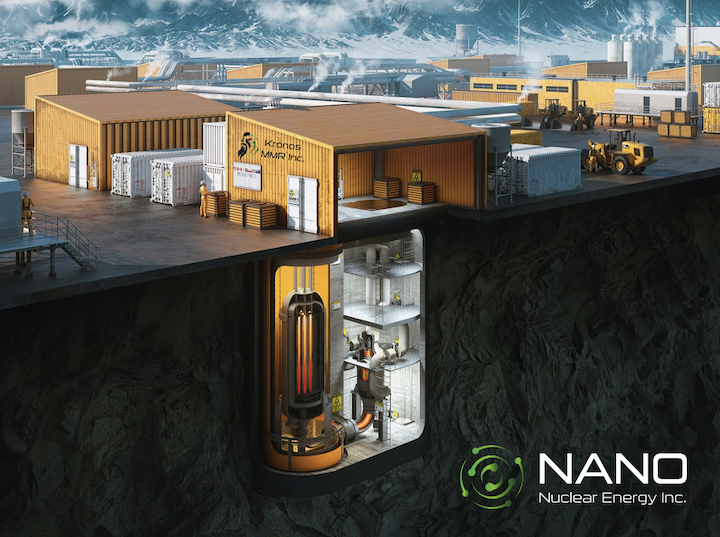
NANO Nuclear Energy Inc. is a company on the cutting edge of nuclear power innovation. It’s responsible for building some of the smallest microreactors in the industry, and if all goes as planned, these machines could democratize nuclear energy in a way that’s never been seen before.
Nuclear energy is enjoying a resurgence in the U.S. However, despite the fact that everyone seems to be talking about it, only a handful of companies are actually building and innovating in the space. NANO Nuclear is one of them.
In October 2025, NANO announced the start of a feasibility study conducted by a potential customer. The study will deploy up to 15 KRONOS reactors to determine whether the units can create a stable, independent power grid capable of sustaining a commercial operation.
Regulatory red tape means it may take some time for those reactors to be built and deployed, but the project is already underway. This isn’t the only major project in store for KRONOS, though.
“In the year ahead, there are several milestones worth highlighting,” says James Walker, CEO of NANO Nuclear. “On the reactor side, advancing our KRONOS microreactor design remains a top priority. We are also advancing a construction project in Canada, as we seek to build and license our design with the CNSC concurrently with the build program here in the U.S.”
“We hope to be the first company in both the U.S. and Canada to construct a fully operational, full-scale, licensed commercial microreactor,” he continues.
NANO Nuclear’s plans for the KRONOS reactor are groundbreaking. If these modular reactors can create and maintain a commercial-scale, independent power grid, they could revolutionize multiple sectors.
While this project progresses, NANO Nuclear is also working toward a goal that sounds like something out of a sci-fi novel: nuclear reactors built for use in outer space.
“The space economy is still in its early phases, but it’s clear that nuclear power will be indispensable as missions move beyond low Earth orbit,” Walker says. “Solar works well for satellites, but for sustained operations on the Moon, Mars, or in deep space, compact and long-duration nuclear systems are the only viable solution. That’s where NANO Nuclear Space is focused.”
Long term bases on the moon, or Mars, or other extraterrestrial bodies will need baseload power to sustain people. Night cycles eliminate solar, moving diesel in quantities necessary to sustain groups of people is just not feasible. Nuclear is the future fuel of space colonization and Nano is working towards being a cornerstone of that advancement.
Although much of NANO’s hands-on work is being done on reactors on Earth, Walker notes that the possibility of using its LOKI reactor to fuel space operations is more than just a passing thought.
“We are already in discussions with other large, established companies seeking to enter the space industry, as both a prime contractor and a supporting contractor,” he says. “Funding opportunities for nuclear-related space endeavors are increasing in number. Like the tech industry, the space companies and agencies acknowledge that nuclear energy has certain benefits that no other power system can render.”
“They recognize the fact that those benefits can facilitate their own long-term ambitions,” Walker continues. “We see opportunities for collaboration with government programs like NASA, as well as with private companies leading the charge in space exploration.”
NANO’s dual push for terrestrial and space-based nuclear power might seem ambitious. However, microreactors have shown the world anything thus far, it’s that smaller reactors might just hold the greatest potential of all.