While terrorism in all its forms is a danger to the United States, the differences in motivations and tactics between international and domestic terrorism efforts are essential to understand when attempting to combat them, a point Frances Townsend, former homeland security adviser to President George W. Bush from 2004 through 2007, has highlighted as critical to any mitigation efforts.
The FBI defines terrorism differently in two separate forms: domestic and international. For international entities, the FBI defines terrorism as “violent, criminal acts committed by individuals and/or groups who are inspired by, or associated with, designated foreign terrorist organizations or nations (state-sponsored).”
But for domestic terrorism, the definition changes, and not just because of where the terrorists originate.
The FBI says domestic terrorism is “violent, criminal acts committed by individuals and/or groups to further ideological goals stemming from domestic influences, such as those of a political, religious, social, racial, or environmental nature.”
‘Look at the Enablers’
Frances Townsend was at the forefront of U.S. anti-terrorism efforts in the first decade of the 21st century, when the primary terrorism threat was from overseas, specifically religious-minded terrorism. And she has a firm grip on how to handle danger, both domestic and foreign.
“When you look at the international fight, we used to look at, what are the enablers?” Townsend told CBS News. “You take away their guns, you take away their communications, you take away their ability to recruit. While domestic terrorism isn’t as hierarchical and organized in that way, there’s responsibility both to take away their guns, right, and make that less accessible, to have social media sites, where they post these hateful manifestos, take those down and notify law enforcement.”
Washington, D.C., think tank The Center for Strategic and International Studies defines religious terrorism as including “violence in support of a faith-based belief system, such as Islam, Judaism, Christianity, or Hinduism.” The primary threat from religious terrorists in the United States, according to CSIS, came from “Salafi-jihadists inspired by the Islamic State and al-Qaida.”
The religious motivations for international terrorism, as it affects the U.S., have been well known for some time. Frances Townsend and other national security officials used this knowledge to help uncover terrorist plots and identify potential terrorists and organizations that had the capability to radicalize individuals.
But while religious-based foreign terrorism is still an issue, the primary danger to the United States over the past several years has been from far-right, domestic groups.
Attacks Overwhelmingly From the Far Right
CSIS data shows that in 2020 terror attacks and plots between January and August of that year were overwhelmingly done by domestic, violent, far-right-wing groups.
According to CSIS, over 40 attacks and/or plots were perpetrated by the far right. The far left accounted for fewer than 15 such instances, while Salafi-jihadist attacks were under five.
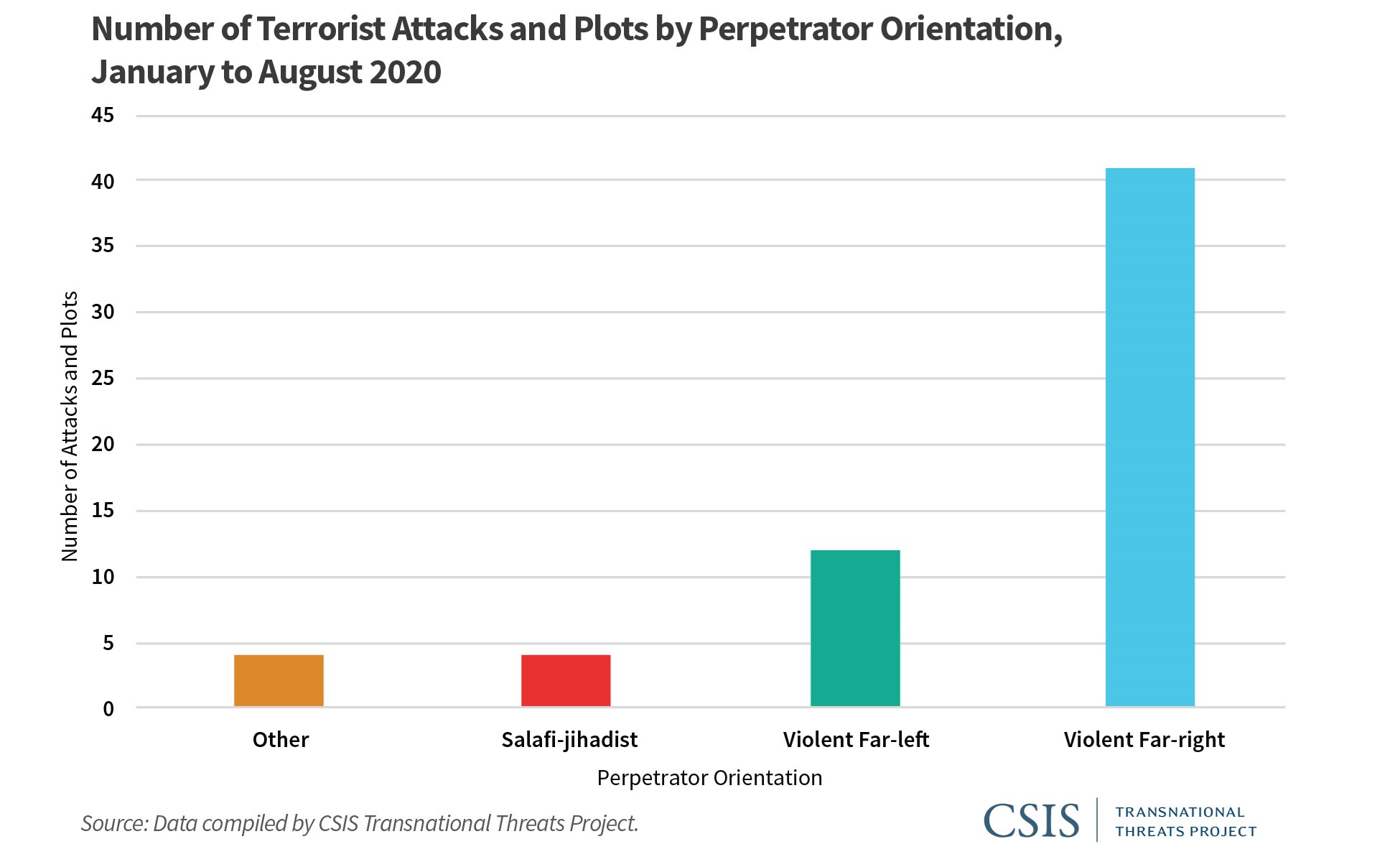
That means 67% of all terrorist attacks during that period were perpetrated by far-right groups.
As far-right groups comprise the vast majority of recent terrorist attacks, it’s worth knowing who or what they are targeting.
While far-left groups, according to CSIS, targeted government, military, or police with 58% of their plots (the other 42% being levied against demonstrators), far-right groups had a different motivation.
For them, half of all plots were against demonstrators. The second-closest category for targets of their attacks was government, military, and police, which accounted for only 18% of the attacks. Another 18% were levied against individuals. A smaller percentage of attacks, noted below, took aim at religious institutions, abortion-related targets, journalists, and the media.

Domestic terrorists in the United States have also taken a divergent approach to the weaponry they use to carry out their attacks.
While explosives and bombs remain a prominent part of terror plots, the far-right terror groups lean more on other forms of violence and intimidation than foreign, mostly religious-based terrorists have.
The far-right groups still used explosives and incendiaries about a quarter of the time, but according to CSIS their most-often-deployed tactic is what the think tank calls “melee”: The terrorists simply embed themselves in protests or demonstrations to sow violence and discord via a good old-fashioned street fight.
‘Community Responsibility’
Frances Townsend found that one of the more effective weapons against foreign terrorism was to get local communities involved to help identify individuals or organizations that foster such behavior.
“You do want the entire community to take responsibility,” Townsend said in 2020 at a Council on Foreign Relations panel on combating terrorism. “And we tried to engage families. So it’s not just the community around this person, it begins with the family. The family will see the first signs before the community sees them.”
But in another difference between how foreign and domestic terrorists are approached and handled, Townsend said the United States hasn’t made the same community-focused efforts in the predominantly white communities where most far-right terrorist groups reside.
“I don’t think that there has been the same expectation placed on white communities that you saw post-9/11,” Townsend said. “I don’t think that’s fair. It’ll be interesting to see with this acceleration over time. That’s when you’re more likely to see sort of a sense of public sense that, wait a minute, why are we continuing to see this and what more can be done? Who else can we engage?”
The Path to Radicalization
While there are significant differences in how domestic and foreign terrorists choose to engage and the manner in which they do so, Townsend has said that there are commonalities that can be evaluated.
“What worries me is I remember when [Osama] bin Laden issued in the late ’90s, the call for an attack in the United States and everybody sort of pooh-poohed that right? Because he issued this threat from a cave, bunch of guys over in Afghanistan,” Townsend said at the CFR forum. “Most people couldn’t find it on a map at the time. It seemed ridiculous. But the manifesto puts a mark on the wall for those who want to belong. There’s a whole radicalization path for those in the white supremacist online community called red-pilling, where they learn the coded language, they begin to understand both the mainstream chat rooms, the social media, and the less mainstream — the [message board website] 8chans of the world.”
In that vein, Townsend has advocated, both as a national security adviser and as a subject matter expert on networks like CNN and CBS, that the U.S. treat domestic terrorism for what it is: a genuine and dangerous threat to the country that needs to be addressed with the same fervency as foreign threats.
“I will tell you that it’s quite conscious and deliberate when we talk about attacks like these, we talk about them as domestic terrorism,” Frances Townsend said. “That’s what they are. Violence against a civilian population to advance a political ideology is terrorism. It doesn’t matter what ethnicity or the perpetrator is. It’s the purpose with which they execute the crime. And it certainly is terrorism. And I think we have to be more disciplined, frankly, in how we talk about the nature of these crimes.”