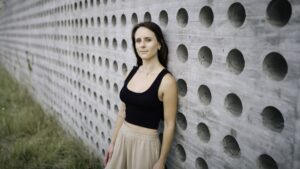
When most people think of mathematics, they picture cold formulas, rigid structures, and precise answers. But for Dr. Kim Dang, a visionary entrepreneur, actress, and former Yale professor of Applied Mathematics, math is anything but sterile. In fact, it’s one of the most powerful lenses she uses to bring clarity to the emotionally tangled moments of real life.
Her unusual career path, from publishing academic work to founding a media production company and launching transformational coaching programs, reflects a deeper belief: that logic and emotion are not opposites. Instead, when used together, they offer a potent framework for helping people make sense of chaos and reclaim their personal narratives.
From Equations to Emotions
Born in Germany to Vietnamese parents and raised in Switzerland, Kim’s life was marked early on by the richness of multiplicity, of culture, language, and eventually, disciplines. After earning a PhD in Mathematics focused on the unpredictable behavior of random matrices, she went on to teach Applied Mathematics at Yale, a place where prestige and intellectual rigor reign supreme.
But even as she explored the deep patterns behind randomness in numbers, something else was stirring. She began to feel a growing pull toward the human stories that numbers could never fully explain. The messiness of life, the heartbreaks, career transitions, identity shifts, called to her in a different language.
And rather than silence that call, Kim made a radical shift. She left her post at Yale to enter the world of film and coaching, founding Dark Runner, a media production company focused on biopics and legacy films, and launching coaching programs like The Art of Starting Over and Quiet Wealth Creation for decision-makers navigating difficult life terrain.
What Chaos Has in Common With Mathematics
So what does math have to do with emotional clarity?
Mathematics teaches you to look at complexity without flinching. It gives you the confidence to sit with unknowns, analyze messy systems, and find patterns where others only see noise.
It’s this mental training that she brings into her coaching work today, especially for high-functioning professionals and creatives who are dealing with emotional upheaval, reinvention, or a sense of being stuck. Whether it’s a CEO stepping away from a legacy role or a parent rebuilding life after divorce, these transitions are often clouded with confusion.
Kim applies structured frameworks to help people sort through the fog.
Just as a mathematician simplifies a chaotic system into meaningful variables, she helps clients identify what truly matters, and what doesn’t.
One of her favorite tools? Thought decomposition.
In math, a complex equation is often broken into smaller, more solvable parts. In life, Kim teaches clients to break overwhelming emotions or decisions into more manageable questions. Instead of asking ‘What’s wrong with me?’ we might ask, ‘What belief am I operating under right now, and where did that belief come from?’ That kind of thinking creates momentum.
Logic as a Liberating Force
Kim is quick to clarify that emotional clarity isn’t about suppressing feelings. It’s about creating space between stimulus and response, something she sees as essential for modern decision-makers who often live in a state of reactivity.
Her programs, especially The Art of Starting Over, help clients build the cognitive and emotional habits necessary to meet uncertainty without spiraling. “When people come to me, they’re not lacking intelligence or ambition,” she notes. “What they’re often missing is perspective, and the tools to access it when everything feels loud.”
That’s where Kim’s analytical roots become an unexpected superpower. Unlike traditional self-help which leans heavily on motivation or affirmations, her method is rooted in reflection and recalibration. Clients learn to treat their inner landscape like a dynamic system, capable of being understood and upgraded.
The Beauty of Patterns, and Breaking Them
Through Dark Runner, Kim also explores emotional clarity through the medium of film, particularly biopics and legacy stories. These are not just creative projects, they’re psychological blueprints.
When you document someone’s story, you start to see what loops they’ve been stuck in, and what breakthroughs changed their trajectory. It’s deeply clarifying, for the subject and for the audience.
And just like in math, recognizing a pattern is the first step toward breaking it. That’s the quiet brilliance of Kim’s approach: she doesn’t impose meaning; she helps others uncover it for themselves.
Her Quiet Wealth Creation program, for example, isn’t just about financial prosperity. It’s about emotional sovereignty, helping people build sustainable lives where their values lead, not external validation.
A New Kind of Intelligence
Kim Dang is proof that intellect and intuition are not in competition. In fact, when used together, they can create something rare, grounded clarity in a chaotic world.
Her journey from mathematics to media, from formulas to film, illustrates what many are just beginning to understand, that the ability to think clearly and feel deeply are not mutually exclusive. They are both forms of intelligence. And both are essential to transformation.
In an age of overwhelm, where identity and purpose are constantly shifting, Kim offers a new model: one where we apply the rigor of science to the art of being human.
Because sometimes, the messiest moments in life don’t need a miracle.
They just need a better equation.