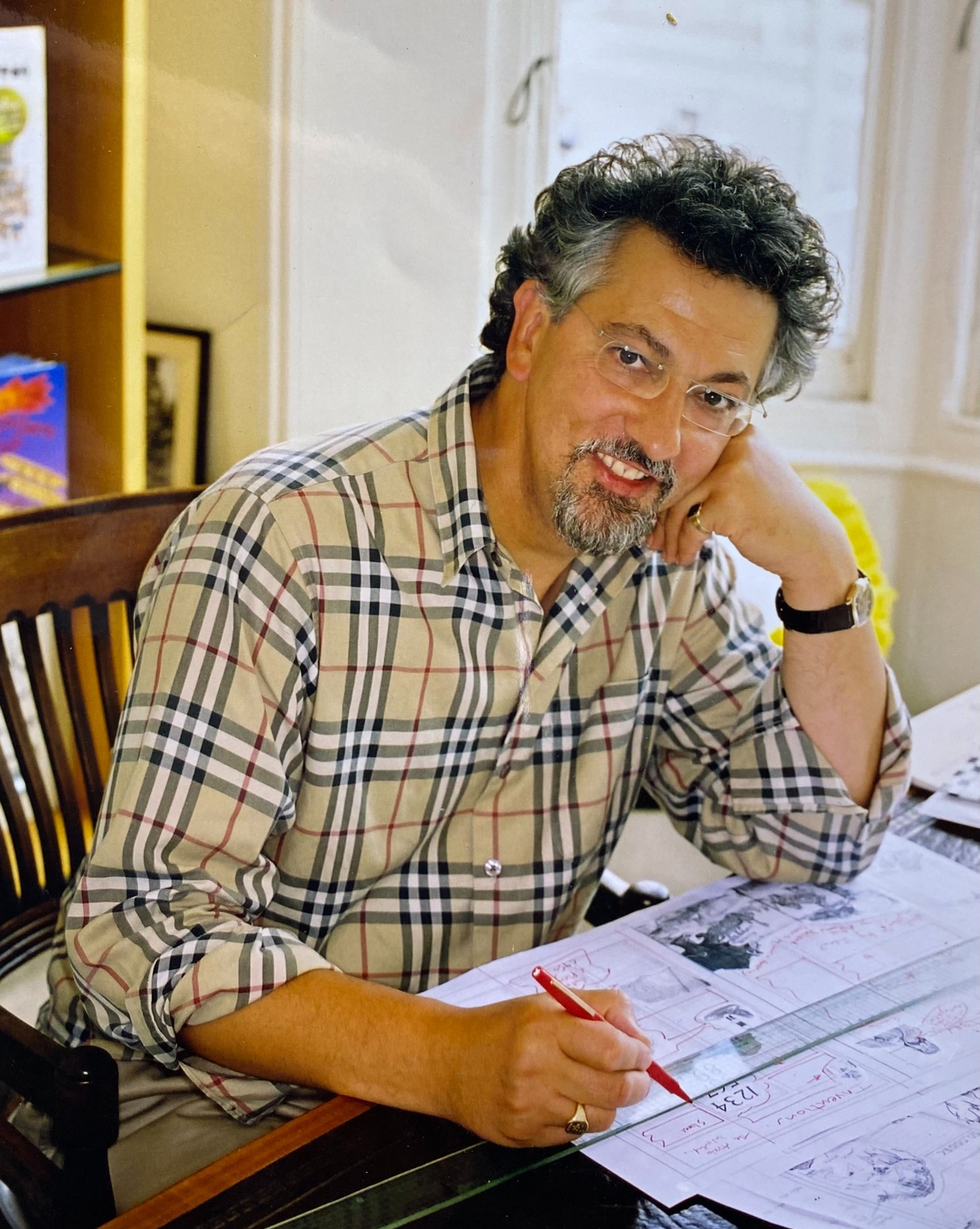
David Salariya is a multi talented creative, with a career spanning over four decades. He is ‘ideas man’, illustrator, designer, author, and publisher. Born in Dundee, Scotland, his Indian/Scottish background has influenced his work in creating and designing books for children of all ages. He writes under the pen-names of David Stewart and Max Marlborough.
David began illustrating books for publishers Reader’s Digest in London and Giunti Marzocco in Florence. He then went on to create and design many award-winning series: ‘Spectacular Visual Guides’,’Timelines,’ ‘The X-Ray Picture Books’,and ‘You Wouldn’t Want To Be…!’ In 1989, he founded The Salariya Book Company, and its imprints: Book House, Scribblers, and Scribo.
David is probably best known as the creator and designer of the bestselling You Wouldn’t Want to Be…! Books. He created and designed this series in 1999, and wrote five of titles as David Stewart: Egyptian Mummy, Roman Soldier, Sail on the Titanic, Tutankamun, Explore with Sir Francis Drake.This sixty book series was brilliantly illustrated by David Antram.
Join me as we explore David Salariya’s remarkable career and his contributions to children’s literature.
Q1: Before founding your business, you worked in various roles. Can you tell us about that time?
David: I did any work, including working on the night shift in a bread factory so I could go out with my portfolio by day. Eventually, I found my first freelance work at Reader’s Digest in London, illustrating the ‘Field Guide to the Trees of Britain.’
Q2: Why are illustrations in children’s books important?
David: Illustrations captivate young minds, an adult sharing a book with a baby invites a child to explore the pictures, question, and discuss the contents. Talking together expands a child’s understanding and vocabulary and bonding goes well beyond the pages.
Q3: How did your education at Duncan of Jordanstone College of Art and your Scottish background influence your work in children’s books?
David: My art education focused on ‘Illustration and Printmaking’ followed by a postgraduate year in ‘Book Design’. My concept for the ‘You Wouldn’t Want to Be..!.’ series drew from the style of the ‘Beano’ comics (and the very English Ronald Searle’s St Trinian’s). My Scottish education was fairly rounded and most importantly probably gave me the attitude to ‘have a go and get on with it!’
Q4: The ‘Inside Story’ series was one of your first global successes. What visual devices did you use?
David: Cutaways, exploded views, cross sections and picture strips, give a dynamic look to information books. The ‘Inside Story’ ‘An Egyptian Pyramid,’written by Jacqueline Morley, illustrated by Mark Bergin and John James, won the Times Educational Supplement Senior Information Book Award in 1991, I later re-designed the series into ‘Magnifications’ and eventually transformed it again into ‘Spectacular Visual Guides‘ in 2009, the series is being republished by the Bonnier UK Hatch Imprint.
Q5: How do you balance humour and factual information in your books?
David: To make information relatable for young readers, try to maintain a conversational and lighthearted tone, ensuring the comedy doesn’t overwhelm the factual material. Match the information and humour to the target age group. Cartoon style art and comic strips make sequences of complex information clearer. The ‘You Wouldn’t Want to Be…’ books are written in the first person and it is the artwork and the speech bubbles which provide the humour.
Q6: How do dynamic illustrations contribute to learning and engagement for young readers?
David: In information books, dynamically drawn illustrations using cross-sections, three point perspective, worm-eye views, bird’s eye-views and using acetate or split pages can provide a cinematic or animated experience. This approach can make books look different adding a novelty element, (economically).
Q7: The You Wouldn’t Want To Be series… is part of many childhoods. What feedback has resonated with you the most?
Teachers and parents say the ‘You Wouldn’t Want To Be…’ series published in the USA/ Australia by Scholastic, attracts reluctant readers and helps adults struggling with reading too. These books offer a unique view of the past ‘warts and all’ providing a source for navigating the complexities of life in the past.
Q8: What motivated you to establish the Stratford-Salariya Children’s Picture Book Prize?
David: Knowing the challenges of being discovered as an emerging talent, I partnered with the Stratford Literary Festival to create the prize. It aimed to find original stories with engaging illustrations that fostered a love of reading in young children. Winning books were published by The Salariya Book Co imprint Scribblers and promoted by the festival.
Q9: What’s new?
David: I’m working on a new series ‘The Good, The Bad, and The Despicably Ugly’, a series of B format history books for ages 9 and up. This project aims to provide a more nuanced view of people and historical subjects by exploring their positive, negative, and the morally complex aspects. Each book will take a 360-degree look at its subject, presenting a multifaceted picture that goes beyond the sensationalism of older history series. This approach offers an understanding of history from all sides, emphasising context and the shades of grey that are in every story..
Q10: Why did you choose to close your company in 2022?
David: Publishing is a challenging business, similar to throwing dice; you score a six in one year, and then you might throw a one for the next six years! Since 2010, my work had become more administration-focused. Of course, having colleagues and a publishing schedule comes with responsibilities, and part of the challenge of being an owner is the inability to let go of your work when you grow tired of it. The pandemic reshaped my perspective and, like many people, made me think about what I wanted for my future. I was hitting 70 and really needed to go back to being more creative. The increasing complexity of managing a small publishing house on my own in an industry dominated by publishing conglomerates was just not what I wanted to do anymore, there comes a point when ‘fighting your battles and keeping your sense of humour’ becomes a losing battle – so I decided after 33 years that the time was right to close. It was challenging to build up a business from nothing, and harder to decide when to sell.
Conclusion:

David Salariya’s contributions to children’s literature has left an indelible mark. His innovative approach to design and dedication to nurturing new concepts continues to inspire. As technology evolves, David’s work demonstrates the enduring value of creativity and imagination in children’s books.
Lear more at: www.davidsalariya.com