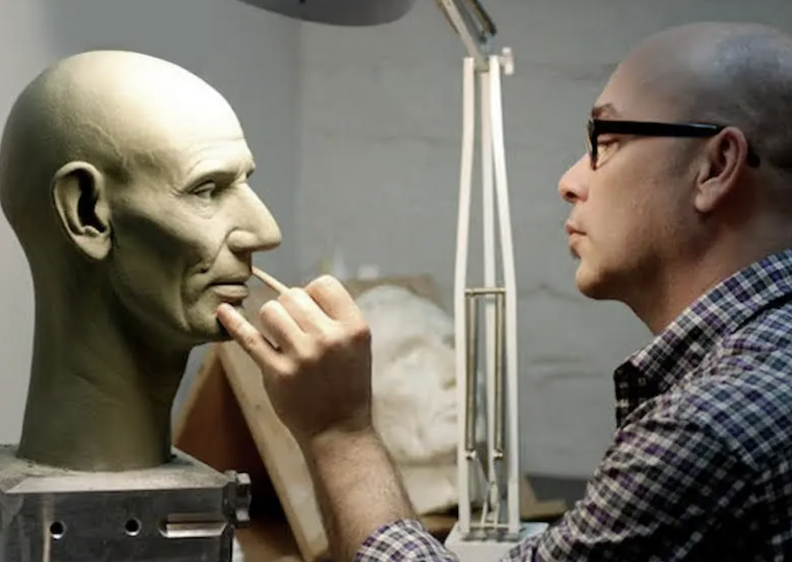
In 2002, when special effects artist Lee Romaire won an Emmy Award for the prosthetics he designed for HBO’s black comedy series “Six Feet Under,” it was a moment that helped kickstart a decades-long career creating award-winning work for films, television, and theme parks. The following year, in 2003, Romaire launched his own studio in Los Angeles.
Yet, Romaire and his team of creatives at Romaire Studios no longer work on television shows and movies to the same extent they used to. Instead, they help major theme parks create attractions that surprise and delight thousands of people every day, but all that changed when Mike Hill approached Romaire about working on Guillermo del Toro’s “Frankenstein.”
“My friend Mike Hill was tasked with creating Frankenstein’s monster for del Toro’s ‘Frankenstein,’” Romaire explains. “Numerous effects needed to be created along with that make-up, and Mike generously reached out to me to do some of that additional work.
Romaire, master creator of live-action animals and characters
Romaire is often asked to create lifelike animatronics of animals due to his background in taxidermy from his childhood. Other notable examples of his work include “Cody,” the green robot baby Frank Ocean brought to the 2021 Met Gala, and the koala puppet that starred in San Diego Zoo’s “KOALAFORNIA” marketing campaign in 2013.
Romaire has also created live-action creatures and other special effects for a long list of other noteworthy projects, including Steven Spielberg’s “War of The Worlds,” “What Just Happened,” “Cats and Dogs: The Revenge of Kitty Galore,” Stephen King’s “Nightmares and Dreamscapes,” and “The Dictator,” and the recent remake of “House Party.”
Romaire and his team have created dragons, elves, aliens, werewolves, a talking white cat named Mr. Tinkles, flying alligators, and much more. For “Frankenstein,” they needed to make a multitude of dead animals, some of which had been mauled by the creature.
The challenge of making animatronic animals
“Animatronic animals, or even just animals in general, are some of the most difficult things to pull off because of the fur,” Romaire explains. “Everyone sculpts what they think the anatomy looks like and then applies fur to it, and it ends up looking very bloated. So, if you’re really taking care to make something realistic, you have to pull the fur off, adjust it down, then redo. Essentially, you have to build twice a lot of times, and most people either don’t or won’t take the time to do that.”
Making the lifelike animal replicas
It took a team of eight people to build the sheep and huskies for “Frankenstein.”
“We used fake fur and sheepskin rugs to create the various animals, and they needed to be period correct, so there was a bit of research involved,” Romaire remembers. “Even animals that would only be on the screen for a brief time needed to fit seamlessly into the world of the story.”
For instance, due to selective breeding, many dog breeds look different today than they would have nearly 200 years ago, when the story in “Frankenstein” was set. Some dog breeds wouldn’t have even existed at that time, which would have made their appearance anachronistic. Sheep also had different builds, and the textures of their coats were different from what they are today, so Romaire and his team studied paintings, engravings, and other images from the period.
“We created the animals’ bodies from foam, articulated them so they could be somewhat poseable, and then applied fur and details,” Romaire says. “The final step was to dirty them up a bit, like real animals are.”
One particularly memorable prop was a dog with its head bashed in. “That was a pretty gory effect and is something we don’t normally do,” Romaire recalls. “We actually got a quick sketch from Guillermo himself on how he wanted it to look and copied that as closely as we could. It looked really horrific, and I’m pretty proud of how realistic it looks because whenever I show it to anyone, they wince. So we pulled it off.”
Lee Romaire: Theme parks’ “secret weapon”
“This was an unusual project for us as we don’t do much movie work anymore,” Romaire says. “These days we usually work on very complicated animatronic figures for theme parks or live experiences, and we also do research and development for new technology attractions in parks.”
Indeed, Romaire has established himself as one of Disney Imagineering and Universal Creative’s most powerful “secret weapons.” He and his team have provided live-action creatures, characters, and props to Star Wars: Galactic Starcruiser at Walt Disney World and the Secret Life of Pets: Off the Leash attraction at Universal Studios Hollywood. He was also the artist who created the likeness of President Abraham Lincoln for Disneyland’s Great Moments with Mr. Lincoln.
Given the wince-worthy animals that Romaire and his team created for “Frankenstein,” it would not be surprising if more film productions come calling in the future.
“We were lucky that Mike reached out, and it was a pleasure working with him,” Romaire says. “He’s one of the most brilliant sculptors in the world, and to get his blessing on this work was an honor for us. It was also a lot of fun, which is important!”