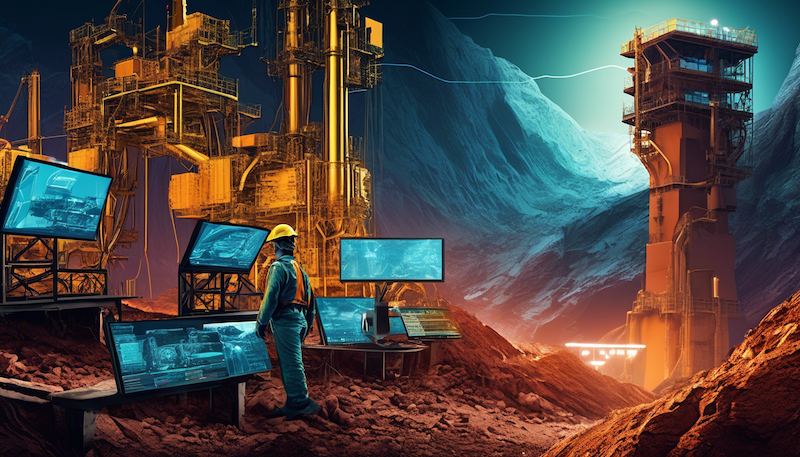
Every second lost in a mining operation isn’t just a blip on a machine log; it is a potential crisis. In this sector, unplanned downtime can cost tens of thousands of dollars per hour. In this sector, unplanned downtime can cost industrial operations up to $125,000 per hour, according to ABB’s 2023 reliability survey. That is not a statistic to be glossed over. It is a gaping inefficiency that causes safety issues, delays, and problems in global supply chains. And the real kicker? Much of it is preventable.
Let’s talk about Electric Rope Shovels, those mechanical giants that dominate surface mining sites. They perform thousands of cycles a day. These machines hoist and haul raw materials with brutal elegance, operating in extremes that would cripple most machines. We’re talking 30°C in arctic zones to a blistering +50°C in equatorial mines, with every moving part vibrating under immense mechanical stress. Dust, noise, temperature spikes, this is not a friendly environment for electronics, let alone the fragile assumptions of outdated maintenance models.
Traditional maintenance has often been based on superstition. People often pray their machines will last until their next scheduled check-up, or they wait until something breaks before fixing it. In today’s data-rich world, that model feels like navigating with a blindfold on. The question isn’t whether machines will fail, but whether we’ll know before they do.
This is where Avadh Nagaralawala steps in. A seasoned Control Systems Engineer working with one of the world’s leading industrial equipment manufacturers, Avadh doesn’t just believe in engineering elegant solutions; he builds them. He had over 11 years of experience in mining automation. He recognized that downtime was a data problem, not just a mechanical one. And solving it required nothing short of a digital nervous system for this firm’s fleet of Electric Rope Shovels.
Avadh was tasked with integrating and validating a real-time vibration monitoring system for these machines. A project that sounds deceptively straightforward until you consider what’s involved. First, there is the data. He had to route raw signals from disparate machine parts- hoist, swing, and crowd motors- into a Vibration Electronic Control Module (ECM) capable of digesting and relaying this information in real time. Then came the challenge of transmitting this data through clouds, GUIs, and analytics engines, each a separate puzzle piece needing perfect alignment.
“The real challenge wasn’t just in building the technology, it was in making the system speak fluently across every level,” Avadh says. “From the heartbeat of the machine to the fingertips of the operator, we had to ensure every signal mattered.”
Avadh ran more than five hundred detailed simulations in order to analyze the system behavior in every extreme condition and operational anomaly. These weren’t lab experiments; they were grounded in over 10,000 hours of live machine time, across multiple ERS models, in real-world mining conditions. He mapped signals meticulously, introduced universal interface protocols, and designed iterative feedback loops so the system could not only monitor but learn. It wasn’t enough to catch failures; it had to predict them.
As expected, it took place. The new vibration monitoring system transformed maintenance practices from reactive to predictive. Operators could now visualize machine health in real time through intuitive dashboards. Algorithms flagged anomalies before they turned into emergencies. Maintenance teams received alerts in advance. These alerts allowed them to schedule interventions during downtime windows rather than being ambushed by breakdowns in the field.
The change was palpable. Unplanned downtime fell by 15 percent. Maintenance planning efficiency improved by 20 percent. Overall productivity rose by as much as 15 percent, and energy consumption dropped by 10 percent. What is potentially more crucial, field technicians reported a 95 percent satisfaction rate post-deployment, a sign not just of technical success, but of human trust and operational confidence.
What Avadh built wasn’t just a monitoring system; it was a philosophy of maintenance made tangible. A belief that machines, when listened to carefully, will always tell you what’s wrong, if you know how to hear them.
The impact of this work didn’t stay confined to one product line. Avadh’s modular design and communication protocols were adopted as best practices across the firm’s heavy equipment portfolio. It became a template for scalable, cloud-integrated, condition-based monitoring, now considered a pillar in the company’s long-term digitalization roadmap.
He is humble about the acknowledgment, but that can never take away from the significance of his work. He trained more than 50 engineers and technicians to use the new system so that the transition would be smooth, and a culture of data-first thinking was instilled on-site. He worked across different teams, from PLC programmers to cloud architects to UI designers, unifying the often dissonant engineering languages into a common language of reliability.
His words speak volumes about his contributions. He shares, “Smart mining isn’t about removing humans from the loop, it’s about giving them sharper eyes and better foresight. The goal isn’t just uptime. It is awareness. It is empowerment.”
In a world inching closer to Industry 5.0, where collaboration between human intelligence and machine systems defines progress. Avadh’s work represents a crucial inflection point. He didn’t invent new machines. He made them think differently, thereby shedding clearer perspectives for the whole industry.
So while all the buzzwords like IoT, digital twin, and AI-driven analytics swirl around, the real revolution is quietly taking shape. It is in the filtered tremors of a motor, the interpreted patterns of wear, and the captured insights from vibration trails. Thanks to engineers like Avadh, those whispers now speak volumes.
And somewhere deep in a mine, in conditions no human should have to second-guess, a machine stays up a little longer, performs a little better, and saves just enough energy to matter. Not because it’s flawless, but because someone finally taught it to ask for help. That’s engineering, not just for efficiency, but for empathy. And in mining, that might just be the most precious resource of all.