There are surfaces that stop people mid-sentence. Zellige tile is one of them.
Walk into any kitchen, bathroom, or entryway where it has been installed and the reaction is almost always the same. People reach out to touch it. They ask what it is. They want to know where it came from. For a material with roots stretching back to 10th century Morocco, zellige tile is having an unexpectedly modern moment and the designers specifying it are not treating it as a trend. They are treating it as a permanent upgrade.
What Zellige Actually Is
Zellige is a form of handcrafted terracotta tilework that originated in Morocco and has been produced using largely the same methods for over a thousand years. Raw Moroccan clay is shaped, fired in traditional kilns, then hand-cut by artisans into individual pieces. The glazing process produces a surface that is inherently irregular. Each tile slightly different in thickness, color depth, and reflectivity. No two pieces are identical. No machine replicates the result.
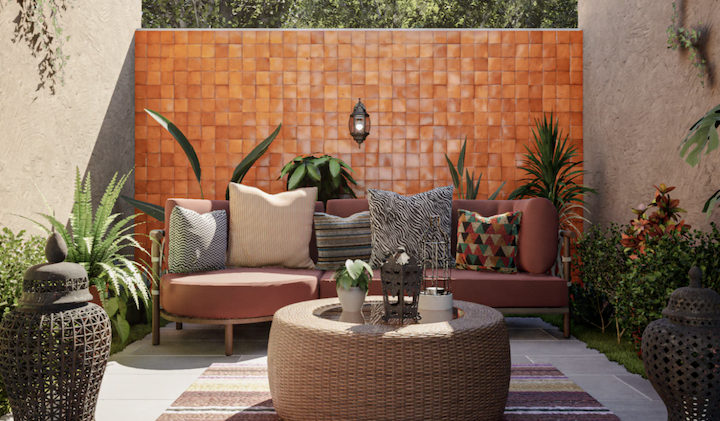
That irregularity is the entire point. When zellige tiles are installed together, the variation across thousands of individual pieces creates a surface that moves with light throughout the day. A wall that reads as a single tone at noon reads as three or four tones by late afternoon. The depth that results is something that photographed images struggle to capture, which is part of why designers who have worked with it tend to be emphatic about it in a way that is hard to explain to someone who hasn’t seen it in person.
Harley Gusman, a contractor and renovation content creator with millions of followers across social media, described the experience of installing zellige in a recent interview. She talked about surfaces you can look at for a long time because the eye keeps finding something new, a quality she contrasted directly with the uniform finish of factory tile. “It looks like a piece of art,” she said. “You’re not just glazing over tile.”
Why It Is Everywhere Right Now
The broader design conversation has been moving toward handmade, imperfect, and culturally rooted materials for several years. What changed recently is that zellige crossed from the trade-only specification world into mainstream residential renovation. A combination of social media visibility, increased availability from US-based suppliers, and a generational shift in how buyers think about permanence and craft has pushed zellige from boutique to broadly sought-after.
Interior designers who once reserved it for hospitality and high-end residential projects are now fielding requests from homeowners who found it on Instagram and decided they want it in their kitchen. The demand is real, and it is growing. According to renovation trend reports tracking 2026 interior design, zellige and zellige-inspired surfaces rank among the most specified materials for kitchen backsplashes, bathroom feature walls, and statement shower applications this year.
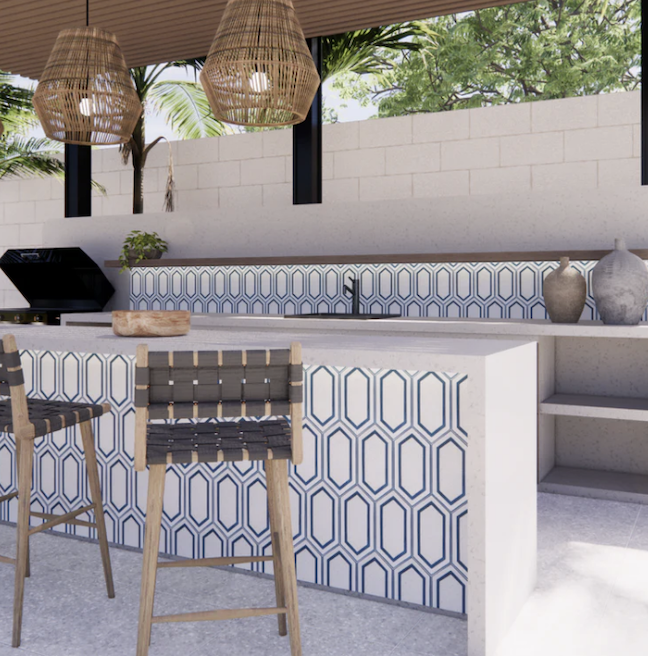
The material works across a wider range of aesthetics than most buyers initially expect. It reads as Mediterranean and Moroccan in traditional settings. In contemporary kitchens with flat-front cabinetry and concrete countertops, it provides texture and warmth that manufactured tile cannot. In transitional spaces it serves as the element that keeps a room from feeling generic. The color range available from established suppliers now spans from classic whites and creams through deep jewel tones, terracotta, sage, and navy, which means the aesthetic limitation that once kept zellige in a niche has largely disappeared.
What to Know Before You Buy
Zellige is not a tile you can approach the same way you approach porcelain. The variation that makes it beautiful also requires a specific mindset going in, and buyers who understand what they are getting tend to be far more satisfied with the finished result than those who don’t.
Color variation between tiles and across a full installation is inherent and significant. The color in a product photo is representative, not exact. Ordering a sample before committing to a full project is strongly recommended, and ordering from a single production lot reduces variation across a large installation. Installers experienced with handmade tile handle zellige far better than those accustomed to working with uniform manufactured product, so the choice of tile setter matters.
Zellige is typically glazed, which means it does not require sealing the way unglazed cement tile does. The glaze provides inherent stain resistance, making it a practical choice for kitchen backsplashes and bathroom walls without the maintenance overhead of other handmade tile types. For floors, the surface irregularity requires more attention to leveling during installation but produces a result that is genuinely unlike anything available in the manufactured tile category.
LiLi Tile’s Zellige Collection
LiLi Tile, the New Jersey-based handmade tile company that has become one of the most referenced names among designers specifying artisan tile, carries an extensive zellige collection sourced from Morocco and produced using traditional clay and kiln techniques. The brand’s zellige offering spans a broad color range and ships from a fully stocked warehouse with lead times significantly shorter than many import-direct competitors.
For designers and homeowners who want to visualize how zellige will look in a specific space before ordering, LiLi Tile’s custom tile visualizer allows pattern and color configurations to be previewed digitally, a tool that addresses one of the most common friction points in specifying handmade tile. Trade pricing is available through the brand’s dedicated design professional program, and the team’s customer service response times have been cited by reviewers as among the fastest in the category.
LiLi Tile’s full zellige collection, along with installation guides and sample ordering, is available at lilitile.com. For a material this dependent on seeing it in your specific light conditions, samples are always worth the step before committing to a full order.
The Longer View
Zellige tile does not age out. Installed correctly in a home or commercial space, it improves with time as the glaze develops a natural patina that deepens its character. The same material that appeared in the architecture of medieval Morocco is being specified today in contemporary residential renovations across the United States, not because it is fashionable but because what it does to a space has no manufactured equivalent.
Designers who have used it once tend to keep using it. That is probably the most honest measure of whether a material is genuinely worth specifying.