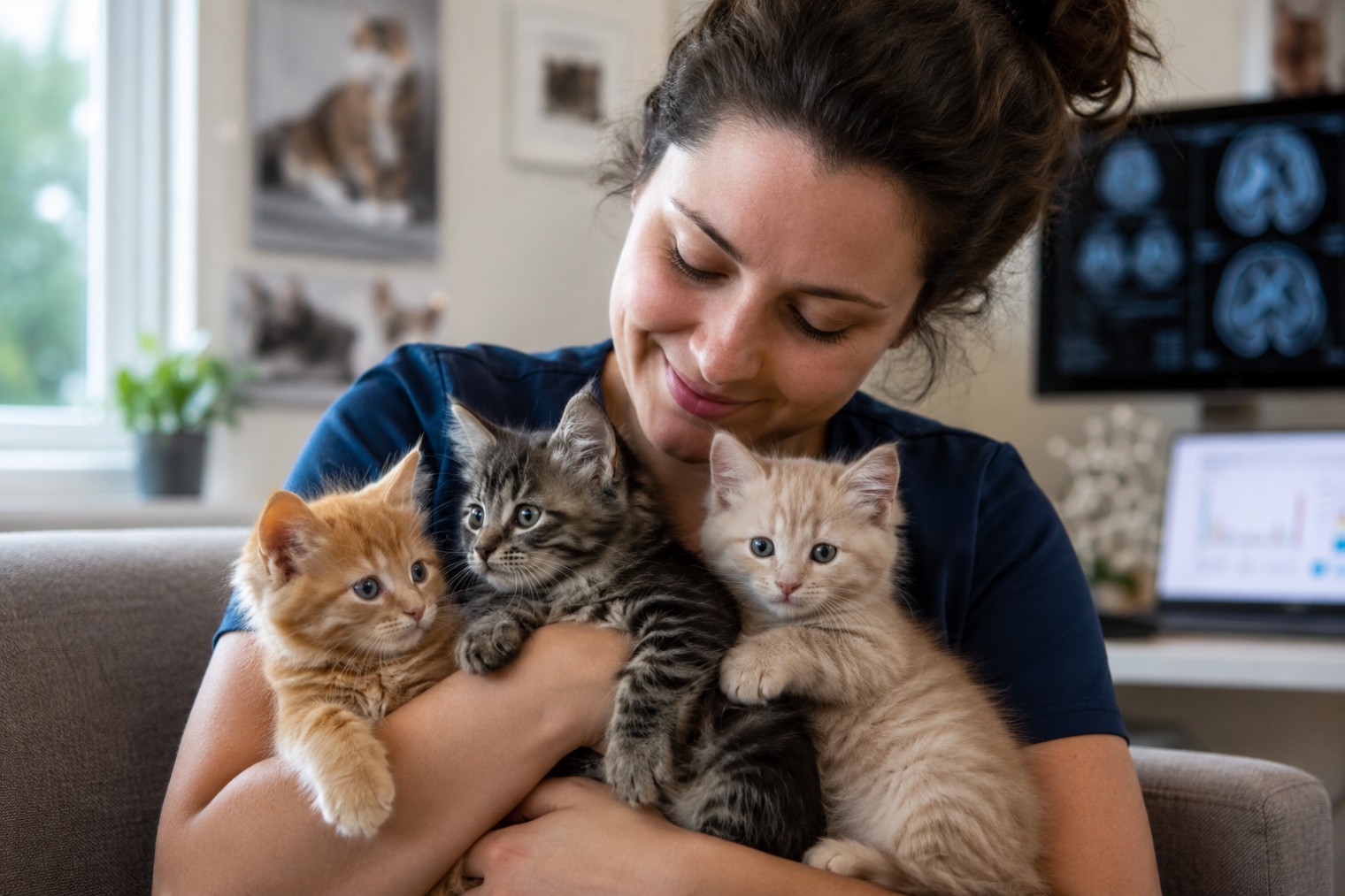
A Maine Coon kitten named Viggo arrived at UC Davis with a head that was visibly too large. His owner, Erin Cooper, had assumed it was just the breed. An MRI told a different story.
The scan revealed feline hydrocephalus, a buildup of fluid inside the skull that compresses brain tissue and is, in most cases, fatal. Viggo was referred to Karen Vernau, a veterinary neurologist at UC Davis, who performed surgery to place a catheter and drain the excess fluid. Months later, follow-up imaging showed thicker brain tissue and a catheter still functioning correctly. Viggo survived.
The case, published in January 2026, drew attention not only because of the outcome but because of what it suggested for human medicine. UC Davis runs one of the few institutions in the world where veterinary and human health teams work in close coordination, and the surgical techniques used on Viggo are being studied as potential models for treating hydrocephalus in infants, a condition that affects roughly one in every 500 human births. The crossover is not incidental. Feline brain anatomy shares enough structural similarities with the human brain that what works in one can, with modification, inform the other.
That crossover is becoming a recurring theme in feline research. In May 2026, scientists at the University of Guelph published findings in the journal Science after genetically analyzing tumors from nearly 500 cats sourced from veterinary centers around the world. The results showed significant overlaps between cancers in cats and cancers in humans, including shared mutations linked to aggressive breast cancer. The study was described by researchers as the first large-scale effort to genetically map cancer across the feline species, and its authors argued it could reshape how oncologists approach certain human cancers by providing a new animal model that is far closer to human biology than the mice that dominate most laboratory cancer research.
Cats, unlike purpose-bred lab animals, develop cancer spontaneously and share living environments with their owners. Their tumors arise from the same mix of genetic predisposition, environmental exposure, and biological chance that drives human cancer. That makes them, in the language of researchers, a naturally occurring model, one that reflects real-world disease rather than disease induced under controlled conditions.
The practical implications are significant. Cancer trials in cats could run faster and more cheaply than equivalent human trials, and because cats and their owners both stand to benefit, the ethical calculus is different from experiments conducted on animals with no stake in the outcome. Several veterinary oncologists have begun referring to companion animals as a bridge species, sitting between lab models and human patients in the pipeline for new treatments.
None of this changes what a kitten actually is in its first weeks of life: a small, mostly helpless animal running on instinct and milk, unable to see or hear, growing at a rate that requires nearly all available energy. The socialization window that shapes an adult cat’s temperament opens around two weeks and closes by seven or eight. The play behavior that looks like chaos is, in biological terms, predator training. The attachment that forms between a kitten and its household is not sentiment but neurological programming, laid down during a developmental period that cannot be recovered once it passes.
What is changing is the scientific standing of the animal itself. For most of the history of biomedical research, cats occupied a marginal position, used occasionally, studied rarely, understood poorly. The recent wave of feline research is beginning to shift that. A species that has lived alongside humans for roughly 10,000 years is turning out to have more to teach medicine than anyone had assumed.
Viggo, as of the January 2026 report, was doing well.